About Me

My photo
El Paso, TX, United States
21, Army Wife, SAHM, Crafter, DIY-er, Bargainer, Crunchy green domestic Goddess, Cloth-diaperin', Baby wearin', breast feedin', organic eatin' Mama!! Follow me on IG @mrsfergiefresh Twitter: mrsfergiefresh Pinterest: Alexis Ferguson
Showing posts with label Green Baby. Show all posts

Saturday, February 8, 2014

Baby Led Weaning or BLW

First things first, what is baby led weaning? "Baby Led Weaning, quite simply, means letting your child feed themselves from the very start of weaning*."  "In the UK, ‘weaning’ means ‘adding complementary foods’, whereas in the States it means ‘giving up breastfeeding’."-  babyledweaning.com 

kellymom.com states:
[The following organizations recommend that all babies be exclusively breastfed (no cereal, juice or any other foods) for the first 6 months of life (not the first 4-6 months):
World Health Organization
UNICEF
American Academy of Pediatrics
American Academy of Family Physicians
Australian National Health and Medical Research Council
Health Canada

Reasons for delaying solids

Delaying solids gives baby greater protection from illness.


Although babies continue to receive many immunities from breastmilk for as long as they nurse, the greatest immunity occurs while a baby is exclusively breastfed. Breastmilk contains50+ known immune factors, and probably many more that are still unknown. One study has shown that babies who were exclusively breastfed for 4+ months had 40% fewer ear infections than breastfed babies whose diets were supplemented with other foods. The probability of respiratory illness occurring at any time during childhood is significantly reduced if the child is fed exclusively breast milk for at least 15 weeks and no solid foods are introduced during this time. (Wilson, 1998) Many other studies have also linked the degree of exclusivity of breastfeeding to enhanced health benefits (see Immune factors in human milk).


Delaying solids gives baby’s digestive system time to mature. 


If solids are started before a baby’s system is ready to handle them, they are poorly digested and may cause unpleasant reactions (digestive upset, gas, constipation, etc.). Protein digestion is incomplete in infancy. Gastric acid and pepsin are secreted at birth and increase toward adult values over the following 3 to 4 months. The pancreatic enzyme amylase does not reach adequate levels for digestion of starches until around 6 months, and carbohydrate enzymes such as maltase, isomaltase, and sucrase do not reach adult levels until around 7 months. Young infants also have low levels of lipase and bile salts, so fat digestion does not reach adult levels until 6-9 months.


Delaying solids decreases the risk of food allergies.

 
It is well documented that prolonged exclusive breastfeeding results in a lower incidence of food allergies (see Allergy References). From birth until somewhere between four and six months of age, babies possess what is often referred to as an “open gut.” 
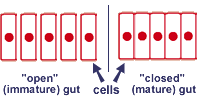
This means that the spaces between the cells of the small intestines will readily allow intact macromolecules, including whole proteins and pathogens, to pass directly into the bloodstream.This is great for your breastfed baby as it allows beneficial antibodies in breastmilk to pass more directly into baby’s bloodstream, but it also means that large proteins fromother foods (which may predispose baby to allergies) and disease-causing pathogens can pass right through, too. During baby’s first 4-6 months, while the gut is still “open,” antibodies (sIgA) from breastmilk coat baby’s digestive tract and provide passive immunity, reducing the likelihood of illness and allergic reactions before gut closure occurs. Baby starts producing these antibodies on his own at around 6 months, and gut closure should have occurred by this time also. See How Breast Milk Protects Newborns and The Case for the Virgin Gut for more on this subject.

Delaying solids helps to protect baby from iron-deficiency anemia.


The introduction of iron supplements and iron-fortified foods, particularly during the first six months, reduces the efficiency of baby’s iron absorption. Healthy, full-term infants who are breastfed exclusively for periods of 6-9 months have been shown to maintain normal hemoglobin values and normal iron stores. In one study (Pisacane, 1995), the researchers concluded that babies who were exclusively breastfed for 7 months (and were not give iron supplements or iron-fortified cereals) had significantly higher hemoglobin levels at one year than breastfed babies who received solid foods earlier than seven months. The researchers found no cases of anemia within the first year in babies breastfed exclusively for seven months and concluded that breastfeeding exclusively for seven months reduces the risk of anemia. See Is Iron-Supplementation Necessary? for more information.
Delaying solids helps to protect baby from future obesity.


The early introduction of solids is associated with increased body fat and weight in childhood. (for example, see Wilson 1998, von Kries 1999, Kalies 2005)


Delaying solids helps mom to maintain her milk supply.

 
Studies have shown that for a young baby solids replace milk in a baby’s diet – they do not add to baby’s total intake. The more solids that baby eats, the less milk he takes from mom, and less milk taken from mom means less milk production. Babies who eat lots of solids or who start solids early tend to wean prematurely.


Delaying solids helps to space babies.


Breastfeeding is most effective in preventing pregnancy when your baby is exclusively breastfed and all of his nutritional and sucking needs are satisfied at the breast.


Delaying solids makes starting solids easier. 


Babies who start solids later can feed themselves and are not as likely to have allergic reactions to foods.
Most babies will become developmentally and physiologically ready to eat solids by 6-9 months of age. For some babies, delaying solids longer than six months can be a good thing; for example, some doctors may recommend delaying solids for 12 months if there is a family history of allergies.
Although some of the reasons listed here assume that your baby is breastfed or fed breastmilk only, experts recommend that solids be delayed for formula fed babies also.]


"after all is said and done, it pretty much comes down to this: There are no benefits, only risks, to starting a baby before they're biologically ready, and since we can't see the gut, we have to go by outside cues, and waiting until a bare minimum of 6 months is the safest way to play it. If a couple weeks is the difference between a gut infection and not, the choice is pretty clear." ---thestir.cafemom.com

I cut and pasted a lot of the science behind delaying solids because those were the same websites I read that helped solidify my decision to delay starting solids until 6 months and following through with baby led weaning. I am only a couple of weeks into BLW but I started with carrots steamed really soft he really liked them and only gagged one time. next we tried avocados cut into thick slices and he absolutely loved them! he probably ate 1/4 of the avocado in one sitting. Next was banana, I just handed him half, and he was sort of so-so about the whole thing, like he could take it or leave it which really surprised me because I had heard babies love bananas. Today he had some cantalope and let me tell you, I have never seen him demand another piece like he did with the cantalope.


Another awesome thing about baby led weaning is that you can save so much money! Seriously, who doesn't love saving money? If you don't you're in the wrong blog, dude/lady. If you have any further questions for me feel free to leave comments in the comments section below. make sure you like my facebook page, and sign up for my email notifications for when a new post is up! thank you for reading and I hope this post can help you make a decision on what's best for your family when it comes to introducing solids.

Tuesday, January 28, 2014

Our Breastfeeding Journey

*A little forewarning: This is my personal story. I'm not writing this to bring down formula feeding mothers. I'm not trying to brag or rub in any mothers face how successful I've been. I'm writing this as a celebration of six months of exclusive breastfeeding. A celebration of my determination, my belief in my son's instinctual need for nourishment from my breast. And as a celebration for women everywhere who can do with their bodies what nature intended. Please don't take offense because that is not my intention.*

    There is so much to say about breastfeeding and I’m not quite sure where to start so I guess I’ll start with me. I had it all planned out, I would go into labor on or around my due date, give a natural, vaginal birth, delay the cord clamping, immediate skin-to-skin and a successful latch, because you know, that’s how every birth should go. Man, was I in for a rude awakening!
    I go in on a Saturday morning for an induction at 42 weeks and 1 day. I didn't give birth until Monday morning at 3:15 am. You can read the details of my birth story here. What transpired after that really still hurts me to this day and I don't know if I'll ever get over it. So there I was, already beat down from my less than perfect induction, sad that I couldn't see my baby for 3 hours(nicu rules), but I was ready to see him and breastfeed him. Ready to do the one thing I knew I could do. No doctor or nurse was going to dissuade me from doing what I had read about and prepared for since the beginning of my pregnancy. Well they did.
I didn't want Henry to have pacifiers or formula. No nipple confusion or bottle preference to hamper an already difficult endeavor. Well, after the first visit to try breastfeeding him a nurse explained to me, in more or less words, "if we don't give him a pacifier he'll be left to cry until they can get to him". Well I already can't be with my baby 24/7 so fine, give him the pacifier so he doesn't have to cry for someone's attention.
After that hurdle Henry began to latch, and for longer than just a few minutes at a time. So there I was, a few hours after giving birth walking back and forth from the nicu and my postpartum room every three hours to feed him. I overslept. By 45 minutes. A nicu nurse comes to my room to scold me and tell me how Henry is hungry and they aren't allowed to give him any formula because I said not to. I felt awful. Why couldn't she come get me after 5 minutes? For God's sake I just had a baby a few hours before, I'm exhausted and my body hurts. So she convinced me to "rest" and let them take over the night feedings and I could come back in the morning well rested. 
    The next morning I head to the nicu rested and ready to nurse my baby. I walk in set up our little station and bring Henry to my breast to latch. He latches for a second and begins to cry. I try again and again. Still crying and no latch. My heart was breaking. My baby had given up on breastfeeding but I wasn't giving up on him. I knew he could do it because he had done so well before. So I give him the bottle.
Upon returning to my room, feeling defeated but not giving up I began to pump. I pumped for about 30 minutes before each feeding and what little colostrum I could get I would give to my son after offering the breast but before giving the formula. This continued the rest of our stay. They sent me home with about 8 cases of the individual liquid formula bottles. "Just in case", as if they didn't believe I could get him back to breast. After all that I had been through, this was the one thing that was totally in my control and I wasn't going to give up.
    On the fifth day of his life my milk finally came in. All of the pumping I did in the hospital made me so engorged. My breast were so swollen, armpit to armpit. and I was in so much pain. I wasn't giving up though. I sent Eli to the store for cabbage to relieve some of the swelling. As soon as we got home from the hospital we laid in bed skin-to-skin, and we nursed as much as he would allow. As often as he wanted. When I felt he wasn't latching I was giving him formula for a medicine dropper. It felt like forever but he was completely back to breast within just a couple of days.

    Those first three weeks were brutal, the next three were a little better and by three months we were old pro's! Henry is such a natural nurser now. 
Once you can get though the initial pain of finding the correct latch their is no pain. If it hurts then there is something wrong, whether it is a latch issue, flat or inverted nipples, tongue and/or lip tie etc. These issues can all be corrected and worked through. Medically diagnosed low supply can be boosted though a special diet.  It's never too late for relactation either if that's what you want to do. There is so much you can do if you just hold on to hope.
    We have been going six months strong with no end in sight. I have been extremely lucky with Henry. I've never had mastitis, supply issues, any latch problems, I have a great support system from my husband, my family and even my friends. You would be surprised that some of my best friends are people I've never met in person but they have the same views as me on a lot of things including breastfeeding and extended breast feeding. Initially I knew I wanted to breastfeed but I didn't know there were benefits past the age of one.
    Well there are a ton! And America seem to be one of a few countries in such a rush to wean. Why? The natural weaning age averages at 4.2 years, so why is the mother of a toddler nursling whispered about? Told he/she is too "old" to nurse. They need "real" food. You're going to give your baby psychological problems. Who decides this? Certainly not science. And in a world obsessed with sex, sexualizing everything from advertising, clothing, to our children why oh why is breastfeeding, the most natural thing we can do, criticized?
    Maybe if everyone, doctors, nurses, parents, grand parents, siblings friends and strangers could be a little more supportive, a smile and a head nod instead of a scowl and a few choice rude words. You don't know the struggles of any mother, breastfeeding or formula feeding alike. So please understand that this is a critical time for any mother and nursing child. Don't criticize her and make yourself look like an ignorant fool. Don't ask her to leave, cover up, or go to the bathroom. She is not feeding her child to make you happy at the same she is not trying to make a statement. She's only doing what nature intended and responding to her child's needs. 


    Thanks to everyone who reads this. Feel free to share my story to your friends on Facebook, pinterest, or follow the rest of our story on Instagram. The more we can change people's perspective on breastfeeding the more normal it becomes.
 I want to thank everyone in my life that has supported me. Especially my husband. Eli is so kind, when I'm feeling weak he reminds me I am strong. When I feel like giving up he reminds me how far I've come. We were destined for each other since day one and I couldn't imagine any other life for me than to be his wife and the mother of our child and future children.


My very first NIP(Nursing in public)


Sunday, January 26, 2014

Silicone teething necklace


As the mother of a beautiful little boy, six months old to be exact, I have been looking for something natural to ease his teething pain. All day long he's gnashing his gums together and looking for anything he can get a grip on to soothe his achy gums. I also have a very distracted nurser. He can't focus, he has to what we call "shift gears" with his feet, scratch me, himself, pretty much everything but nurse. But I've finally found something that can soothe his gums, help him focus during our nursing sessions, and is a fashion statement for me.

Kate Kidwell owner of http://mistermanpants.com/ :

"Silicone Teething Beads!!! These necklaces and bracelets are for both Mom and baby. Wear something fun and fashionable that your baby will enjoy chewing on. There is a nice tight knot between each bead on some of the necklaces. It also has a plastic breakaway clasp." 

These necklaces and bracelets are BPA, Phthalate and Lead free,
durable, feature matte finish beads, are easy to clean, and some styles have a knot between beads so if to break only one bead drops(not all styles have this feature).
This product has been a Godsend! Henry loves it, I love it and I constantly get compliments on it.
   So for my lucky readers only http://mistermanpants.com/ has given me a coupon code for 10% off of your online order and free shipping on orders over $30! MisterManPants.com also has sunbaby cloth diapers, wetbags, trainers, Baltic Amber, decals, and taggies. 
 Your exclusive coupon code is "MostlyMeatless". Now head on over and go shopping!! 
Thanks for reading, 
                        M-M-M

*Disclosure*
This necklace is not intended to be worn by your baby. It is for your baby to chew on under supervision only. Inspect periodically for damages before allowing your child to chew on it.

Sunday, January 19, 2014

Cloth Diapering 101


So I have been asked by a few moms how and why on earth do I do it? First off, you save SO MUCH MONEY!! So I found these charts with the help of google to show you how much *on average* you spend on disposable diapers. Not to mention that these cost only calculate per child, so double or triple prices depending on how many children you have or want to have.


Okay so this next chart is a little on the higher cost side. I can tell you from my own personal experience it is way cheaper than this to CD. I mostly use pockets now that my little dude's thighs are bigger. I buy diapers from eBay around 5-7 dollars a piece. NOT 20 and up. That's crazy talk to me! my personal stash of about 35 diapers at lets say $6 bucks a piece cost is a total of $210 dollars not only for one baby but for 10 babies if I felt like it! I'm not that crazy though, four maybe but don't tell my husband ;). 
Wipes can be made from anything. Literally. My wipes consist of and organic cotton ones I ordered from etsy ($20 for 20 pieces), and cut up recieving blankets or tee shirts, but if you do the DIY route I would suggest sewing a basic edge because it will fray in the wash unless you use those jagged craft scissors. And to moisten the wipes I just use plain old water in the peri bottle the hospital gave me. Easy peasy right? you will also need a pail liner which is basically a fancy PUL bag that goes into any ordinary  kitchen trashcan, if I could of done it differently I would of bought two. So when one is in the wash you still have something to put diapers in. they cost about 20 a pieceor 40 for two. If you want to use diapers for when you go out you will also need a wet bag those cost about $8-10 dollars a piece. 
So my grand total to cloth diaper is about $260-300 versus $1,500-$4,000 depending on your brand of choice. That alone makes it so worth giving cloth a chance.

This is a breakdown of each type of cloth diaper. 


How to Wash:
I have a normal washer and dryer, none of that fancy front loading stuff. I usually run through the wash twice. First with detergent that I make. you can find the recipe here: http://www.mostlymeatlessmama.blogspot.com/2014/01/homemade-detergent-little-elbow-grease.html
secondly with a hot wash cold rinse. 

Additional Pro's to Cloth Diapering:

  • Money saving as shown above
  • Extra cushion for falls
  • Better for the enviornment
  • Less leaks and blowouts
  • No disposable diaper smell
  • Less likely to get diaper rash
  • potty train sooner because they can feel a wet sensation vs. disposables
  • no harsh chemicals on your baby's most delicate skin.
  • depending on how many additional washes a week you do water and energy cost only go up by a few dollars I do about 3 washes a week
  • Freaking Adorable! many different prints and colors to choose from.

Cons:

  • Can be bulky and you may need to buy a size up in clothes
  • bigger diaper bag

  • time to wash, stuff and organize
  •  Inital cost vs. spread out cost of disposables
  • pockets, need to be line dried or put on a drying rack
  • may be hard for babysitters or grandparents at first
  • there is definitely a learning curve but once you get the hang of it it's easy.
  • You need a CD safe detergent


This my diaper bag that I use for short trips and quick errands, it is also my purse.
And this is the bag I use for when we will be out all day.


If you have any additional questions feel free to leave me a comment and I will get back to you ASAP.


http://www.mothering.com/community/a/cloth-diaper-cost-is-it-worth-it Chart 1 &2

http://fitnessista.com/2011/10/what-i-learned-about-cloth-diapers/ Chart 3